
A beautiful home is easy to appreciate on the day it is completed.
The real test of good interior design comes five, ten or even fifteen years later.
Does the wood still look beautiful? Does the stone develop character rather than stains? Do the walls still feel sophisticated? Does the kitchen finish survive everyday cooking? And perhaps most importantly, does the home still feel relevant when design trends have changed?
This is where material intelligence becomes important.
Material selection is not simply about choosing a colour, texture or finish that looks attractive in a sample book. In Indian homes, materials have to respond to heat, humidity, dust, sunlight, monsoons, frequent cleaning and everyday wear. A finish that looks exceptional in a showroom may not necessarily be the right choice for a particular home or climate.
Today, luxury interiors are moving away from surfaces that simply look expensive toward materials that perform beautifully and develop character over time. Current Indian design conversations increasingly emphasise tactile surfaces, natural stone, wood, lime-based finishes, patina and material authenticity.
At Veda Studio, this means asking a more important question:
Will this material still look beautiful after life happens to it?
1. What Does It Mean for a Material to “Age Beautifully”?
Not every durable material ages beautifully and not every material that changes over time is failing.
There is an important difference between ageing and deterioration.
Ageing can mean:
- Wood becoming deeper and richer in tone
- Brass developing a natural patina
- Stone becoming smoother through years of use
- Natural textures becoming more expressive
- Small variations adding individuality to a surface
Deterioration, on the other hand, can mean:
- Warping
- Swelling
- Peeling
- Cracking
- Discolouration
- Delamination
- Corrosion
Good design anticipates how materials will behave rather than assuming they will remain exactly as they looked on installation day.
Recent Indian design commentary has highlighted this distinction particularly well: natural materials such as stone, wood and lime-based finishes can develop visible character over time, while poor detailing and unsuitable materials can lead to premature failure.
2. Why Indian Homes Need a Different Material Strategy
India doesn’t have one uniform climate.
A home in Ahmedabad experiences very different conditions from a coastal home in Mumbai, a monsoon-heavy home in Kochi or a colder residence in the Himalayas.
Materials therefore need to respond to their environment.
Some of the biggest factors include:
Heat:
Extreme summer temperatures can cause expansion and contraction in certain materials.
Humidity:
Moisture can affect wood, boards, laminates, metals and fabrics.
Monsoons:
Water exposure makes moisture resistance particularly important in kitchens, bathrooms, balconies and lower floors.
Dust:
Highly glossy surfaces can make fingerprints, dust and scratches much more visible.
Sunlight:
Strong UV exposure can gradually affect colours, finishes and certain materials.
This is why “premium material” doesn’t automatically mean “best material.”
The right material is the one that works for the space, climate and lifestyle.
3. Natural Stone: Luxury That Can Become More Beautiful With Time
Stone has remained relevant in Indian architecture for centuries and for good reason.
Materials such as granite, sandstone, Kota stone and marble can offer exceptional longevity when selected and detailed appropriately.
Natural stone also has something manufactured surfaces often struggle to replicate:
Natural variation.
No two slabs are exactly identical.
Veining, mineral variation, texture and subtle changes in colour can give a space a sense of individuality.
Architectural Digest India has highlighted Indian homes where stone is used as a central part of the material palette, particularly because of its durability, texture and ability to gain depth with age.
But stone selection needs intelligence.
For example:
Polished stone
→ Dramatic and reflective
→ Shows fingerprints, scratches and marks more easily
Honed stone
→ Softer visual appearance
→ More understated and contemporary
Brushed/textured stone
→ Adds tactile depth
→ Can work particularly well in relaxed, natural interiors
The objective isn’t necessarily to find the most expensive stone.
It is to find the right stone for the right application.
4. Wood: Choose Character Over Perfection
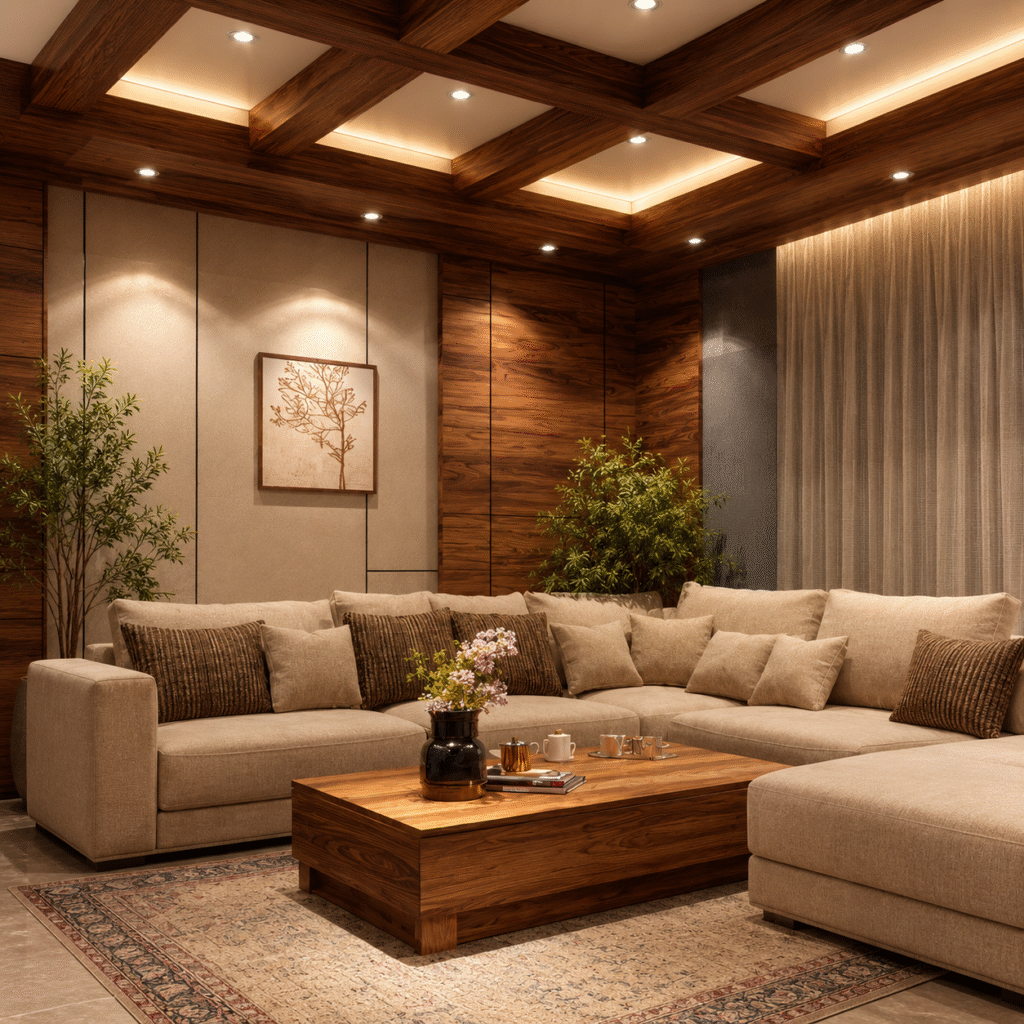
Wood brings something unique to interiors: warmth.
It can soften marble, balance concrete, add depth to neutral interiors and make large contemporary spaces feel more human.
But wood is also sensitive to environmental conditions.
Heat and humidity can cause wood to expand and contract, which makes the choice of substrate, treatment and finish extremely important in Indian conditions.
For long-lasting interiors, consider:
- Quality plywood substrates
- Properly treated wood
- Appropriate veneers
- Correct edge finishing
- Suitable protective coatings
- Climate-appropriate applications
Veneer can be especially effective when you want the visual richness of real wood while maintaining a more controlled contemporary appearance.
And there is another advantage:
Wood doesn’t need to look perfect forever.
A well-designed wooden surface can develop small changes in tone and texture that make the home feel more personal.
5. Matte Finishes: The New Definition of Understated Luxury
For years, high-gloss surfaces were associated with luxury.
But the design conversation is changing.
Today’s interiors increasingly favour matte, honed and tactile finishes because they create softer reflections and a more relaxed visual environment. Veda Studio’s own 2026 material-trend coverage identifies this shift from high-gloss surfaces toward matte and tactile materials.
Why matte finishes work so well:
- They reduce harsh reflections
- They feel visually softer
- They can hide minor fingerprints better
- They work beautifully with natural materials
- They create a more contemporary atmosphere
Instead of making every surface shine, designers are increasingly using texture to create richness.
That is an important shift:
Luxury doesn’t always have to reflect light. Sometimes it absorbs it.
6. Engineered Materials: When Performance Matters
Natural materials have character, but engineered materials have their own strengths.
Modern surfaces such as quartz and porcelain can provide:
- Consistency
- Durability
- Easier maintenance
- Greater design flexibility
- Reliable performance in high-use areas
Veda Studio’s current material-trend research also points toward engineered surfaces increasingly being used alongside or instead of conventional marble, particularly where performance and maintenance are important.
This doesn’t mean natural materials are disappearing.
Instead, the smartest interiors are often about knowing where each material makes sense.
For example:
Kitchen countertop:
Performance and stain resistance may take priority.
Living-room feature wall:
Natural stone may be worth choosing for its uniqueness.
Wardrobe shutters:
A durable matte laminate may be more practical than a delicate finish.
Bedroom:
Wood veneer can introduce warmth and tactility.
Material intelligence is about making those distinctions.
7. The Kitchen Is Where Material Intelligence Matters Most
A kitchen may look beautiful in a showroom because it isn’t being used.
At home, it faces:
- Oil
- Water
- Heat
- Steam
- Food stains
- Frequent cleaning
- Heavy daily use
That makes material selection particularly important.
The base material, edge treatment, surface finish and hardware all contribute to long-term performance.
For moisture-prone applications, appropriately specified BWP/marine-grade plywood and properly sealed edges can be more dependable than moisture-sensitive boards.
The goal isn’t simply:
“Does this kitchen look luxurious?”
The better question is:
“Will this kitchen still work beautifully after thousands of meals?”
8. Walls: Texture Can Age Better Than Trends
Paint colours change.
Wallpaper trends change.
But tactile wall treatments can offer a different kind of longevity.
Depending on the architecture and climate, designers can explore:
- Lime-based finishes
- Natural stone
- Textured plaster
- Wood
- Microcement
- Clay-inspired surfaces
- Hand-finished textures
Natural and breathable finishes are receiving renewed attention in Indian design conversations, especially where they can respond appropriately to local climate conditions.
The key is restraint.
Instead of covering every wall with texture, choose one or two architectural moments where material becomes part of the identity of the home.
9. Brass, Metal & The Beauty of Patina
Metal is another material where ageing can become part of the design.
Brass, copper and certain other metals can develop patina over time.
That change doesn’t necessarily need to be removed.
In fact, the ageing process can become part of the aesthetic.
Imagine:
A brass handle becoming slightly darker around the edges.
A copper surface gradually becoming deeper in tone.
A metal fixture developing subtle variations from repeated touch.
These details can tell a story.
Instead of designing a home where everything must remain untouched, designers can create spaces where use becomes part of the visual language.
10. Don’t Choose Materials Room by Room Choose a Material Language
One of the biggest mistakes homeowners make is selecting every finish independently.
A marble floor is chosen because it looks beautiful.
A laminate is selected because it is trending.
A wood veneer is chosen because it looks premium.
A brass finish is added because it looks luxurious.
Individually, everything may look good.
Together, the home may lack cohesion.
A stronger approach is to create a material palette.
For example:
Warm Contemporary
- Walnut veneer
- Honed beige stone
- Matte beige surfaces
- Aged brass
- Textured plaster
Modern Indian
- Kota stone
- Natural wood
- Handmade textures
- Brushed metal
- Neutral fabrics
Contemporary Luxury
- Large-format porcelain
- Dark wood
- Soft stone
- Sculptural metal
- Layered lighting
The materials don’t need to match.
They need to belong together.
11. Design for Maintenance, Not Just Installation Day
A material’s beauty means very little if maintaining it becomes a daily frustration.
Before choosing a finish, ask:
How will this surface be cleaned?
How often will it require maintenance?
What happens if it gets scratched?
How does it respond to moisture?
Will sunlight affect it?
Can the finish be repaired or refinished?
These questions are particularly important for high-use areas.
A slightly less dramatic finish that can survive everyday life may ultimately be a better luxury choice than a delicate surface that constantly requires maintenance.
12. The Most Important Material Is Often the One You Don’t See
Beautiful surfaces attract attention.
But what happens underneath them is equally important.
A premium veneer cannot compensate for a poor substrate.
A beautiful stone installation can fail because of poor preparation.
A sophisticated wall finish can deteriorate if moisture problems aren’t addressed first.
As recent Indian architecture coverage notes, base preparation, waterproofing, joints, detailing and construction quality can determine whether a material develops a desirable patina or simply deteriorates.
This is why material selection should happen during design not at the last stage of execution.
13. A Simple Material Intelligence Checklist
Before approving any finish for your home, ask these seven questions:
1. Does it suit my climate?
Hot, dry, humid, coastal or cold conditions can change the right specification.
2. Does it suit the room?
A bathroom and bedroom don’t have the same material requirements.
3. How will it age?
Will ageing create character or visible deterioration?
4. How much maintenance does it require?
Be realistic about everyday life.
5. Can it handle my lifestyle?
Children, pets, cooking, entertaining and heavy footfall all matter.
6. Can it be repaired?
A repairable material can be more valuable over decades.
7. Will I still love it when the trend disappears?
This is perhaps the most important question.
14. From Trend-Driven to Time-Driven Design
Interior trends will always change.
Today it may be dark wood.
Tomorrow it could be another colour palette.
One year it may be marble.
Another year it may be textured stone.
But a well-designed home shouldn’t need a complete makeover every time the trend cycle changes.
Instead, use trends selectively.
Let architecture, proportion, materials and craftsmanship create the foundation.
Then allow furniture, art, accessories and smaller elements to evolve.
That’s how a home can remain contemporary without constantly chasing what’s new.
Conclusion: True Luxury Is Designed for Time
The most beautiful home isn’t necessarily the one with the most expensive materials.
It is the one where every material has a reason to be there.
A stone chosen for its durability.
Wood selected for its warmth.
A matte finish chosen for its understated character.
A metal selected because its patina will become more beautiful.
A surface chosen because it can survive everyday life.
That is material intelligence.
Because great interior design isn’t about freezing a home at the moment it is completed.
It is about creating a space that becomes more personal, more comfortable and more beautiful as you live in it.
The best materials don’t simply survive time. They tell its story.